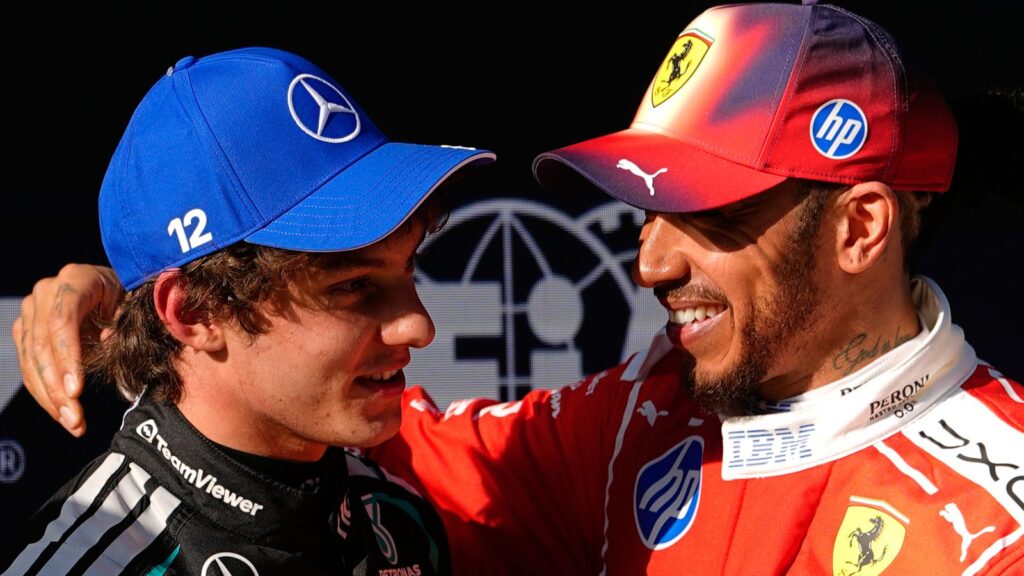
International Media Reacts: Questions Around Lewis Hamilton and Rising Pressure from Kimi Antonelli
Breaking news from the global motorsport scene has ignited widespread debate, as international media outlets weigh in on the current form of Lewis Hamilton and the rapid emergence of Kimi Antonelli as a potential disruptor within the Formula 1 landscape. Headlines suggesting that Hamilton appears “lost” while Antonelli is becoming a “major problem” reflect a shifting narrative in one of the world’s most competitive sports.
For over a decade, Lewis Hamilton has been synonymous with excellence in Formula 1. A multiple-time world champion and one of the most successful drivers in the sport’s history, Hamilton has built a reputation on consistency, resilience, and an unmatched ability to deliver under pressure. However, recent performances and evolving team dynamics have led some observers to question whether he is currently struggling to find his rhythm.
The term “lost,” as used by sections of the international media, does not necessarily imply a decline in ability but rather a moment of transition. Formula 1 is a sport defined by fine margins, where changes in car performance, team strategy, and competition levels can significantly impact results. For Hamilton, adapting to these shifting conditions has become increasingly complex, particularly as younger drivers continue to raise the bar.
Enter Kimi Antonelli, one of the most highly regarded young talents in motorsport. The Italian driver has quickly gained attention for his exceptional skill, composure, and rapid progression through the ranks. Many within the racing community see Antonelli as a future star, and his development has not gone unnoticed by teams, analysts, and fans alike.
The notion that Antonelli is becoming a “major problem” speaks less to any direct rivalry and more to the broader implications of his rise. In Formula 1, the emergence of a new generation often signals a shift in the competitive order. Young drivers bring fresh energy, adaptability, and a willingness to push boundaries—qualities that can challenge even the most established figures in the sport.
For Hamilton, this evolving landscape presents both a challenge and an opportunity. Throughout his career, he has faced and overcome numerous rivals, from seasoned champions to ambitious newcomers. His ability to adapt has been a defining feature of his success. Yet, the current wave of talent, including drivers like Antonelli, represents a new kind of competition—one shaped by different training methods, technological familiarity, and a fearless approach to racing.
International media coverage has amplified these narratives, often framing them in dramatic terms. Such portrayals are not uncommon in Formula 1, where storylines play a significant role in shaping public perception. While headlines may suggest tension or decline, the reality is often more nuanced. Hamilton remains a highly capable and experienced driver, and moments of difficulty are a natural part of any দীর্ঘ career in elite sport.
At the same time, Antonelli’s rise highlights the importance of long-term planning within teams. Identifying and nurturing young talent is crucial for sustained success, and drivers like Antonelli represent the future of the sport. His performances in junior categories have already demonstrated a level of maturity and skill that belies his age, making him a driver to watch in the coming years.
The interplay between established champions and emerging stars is one of the most compelling aspects of Formula 1. It creates a dynamic environment where experience meets innovation, and where each generation learns from the last while striving to surpass it. In this context, the narratives surrounding Hamilton and Antonelli can be seen as part of a broader story about the evolution of the sport.
For fans, these developments add an extra layer of excitement. The prospect of new rivalries, changing hierarchies, and unexpected outcomes keeps the sport fresh and engaging. Whether Hamilton can rediscover his peak form or Antonelli continues his upward trajectory, the uncertainty itself is a key part of Formula 1’s appeal.
It is also important to consider the role of teams in shaping these narratives. Performance in Formula 1 is not solely dependent on the driver; it is a complex interplay of engineering, strategy, and collaboration. Any assessment of Hamilton’s current situation must take into account the capabilities of his car, the decisions made by his team, and the broader competitive environment.
Similarly, Antonelli’s progress will depend on the opportunities he receives and the support structures around him. Transitioning from junior categories to Formula 1 is a significant step, and even the most talented drivers require time to adjust. While expectations are high, patience will be essential in evaluating his long-term impact.
Ultimately, the contrasting stories of Lewis Hamilton and Kimi Antonelli reflect the cyclical nature of sport. Legends rise, dominate, and eventually face new challengers who seek to carve out their own legacies. This process is not a sign of decline but rather a testament to the sport’s vitality and continuous renewal.
As the season unfolds, both drivers will have the chance to shape their narratives. Hamilton’s experience and determination could see him reassert his position at the top, while Antonelli’s potential may begin to translate into tangible success at the highest level. The outcome remains uncertain, and that uncertainty is what makes Formula 1 so captivating.

In the end, the headlines may focus on conflict and contrast, but the deeper story is one of transition and possibility. Lewis Hamilton is not simply “lost,” nor is Kimi Antonelli merely a “problem.” Together, they represent different chapters of the same story—a sport constantly evolving, driven by talent, ambition, and the relentless pursuit of excellence.