The recent commotion around Alessia Russo speaks more about contemporary football culture than it does about the athlete. Every opportunity lost turns into a viral video. Every subdued performance serves as a pretext for naysayers to doubt her abilities. However, those who genuinely comprehend the game continue to support her while the online community rushes to disparage players.
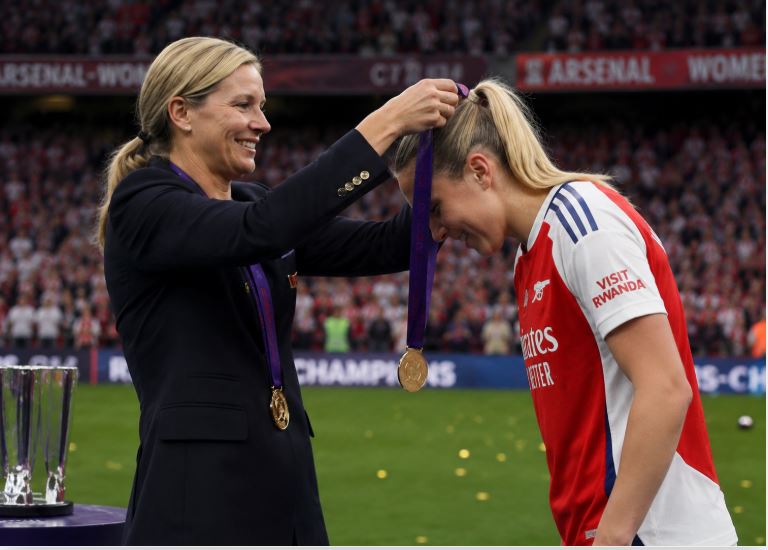
For this reason, it seems so potent to see Kelly Smith laying a crown on Russo’s head symbolically.
It stands for deference. acknowledgment. legacy.

In English football, Kelly Smith understands what it means to have expectations. She is aware of the strain associated with wearing the club and national insignia. More significantly, she is aware of how draining it can be when supporters personalize criticism. In the current social media world, it is difficult to distinguish between helpful criticism and unrelenting negativity, and players like Russo frequently become easy targets just because they are well-known, ambitious, and successful.
However, the loudest critics are rarely remembered in sports history.
The players who consistently showed up are remembered.
Russo has already produced incredible moments for both the team and the nation. Her influence is indisputable, from her iconic performances with England to her rise to prominence as one of the most significant attacking players in women’s football. Even while online opinions vary greatly from week to week, coaches and players greatly admire her movement, intelligence, pressing ability, and poise in crucial situations.
The so-called “haters” overlook a crucial point: excellent football players don’t just happen to be at the top. They endure because they are resilient in ways that most people cannot fathom.
For this reason, so many fans find emotional resonance in Kelly Smith’s symbolic act of “crowning” Russo. It’s like a legendary football player coming forward to say, “Enough.” Put an end to your rudeness. A world-class athlete shouldn’t be reduced to trending discussions and harsh comments.
It also feels, in many respects, like an apology on behalf of a segment of the fan base that occasionally overlooks the human aspect of sports.
Gamers are not machines. Every week, millions of people watch and evaluate their every move as they compete under extreme pressure.
If Russo’s career has demonstrated anything thus far, it is that she reacts best when questioned. Her tale is still being written. Her goals, performances, and impact on the game will all continue to be criticized.
Maybe there’s more to that crown than just symbolism.
Maybe it’s an acknowledgement that Alessia Russo has already earned a spot among the faces influencing women’s football’s future.