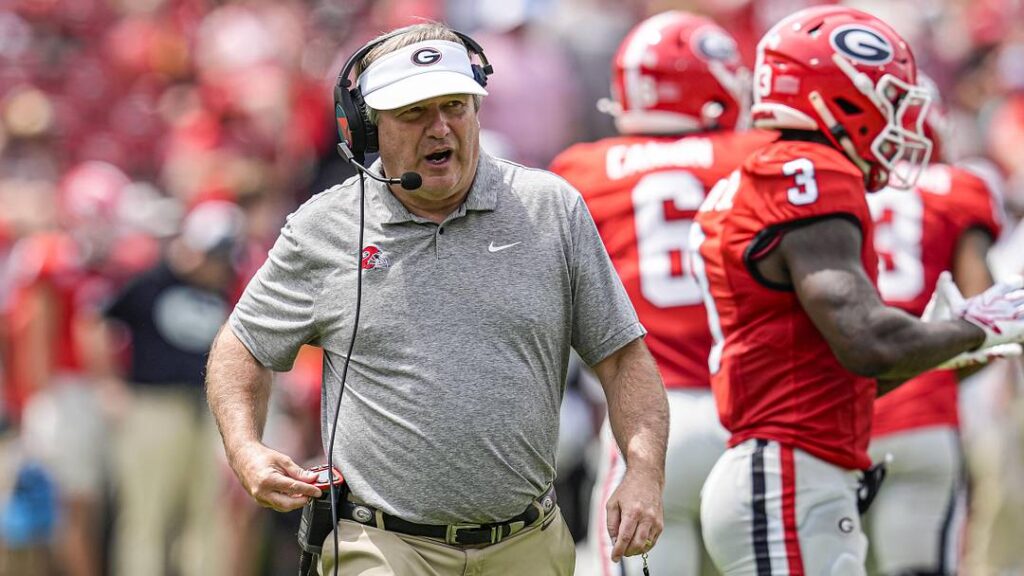
ABC News: Kirby Smart Says Georgia Is “Younger Than Ever” – Why It’s Not a Problem for the Bulldogs
Georgia Bulldogs head coach Kirby Smart has sparked major discussion across college football after stating that his team is “younger than ever” heading into the new season. While some programs might view such a situation as a rebuilding phase filled with uncertainty, Smart’s message carried a very different tone—confidence, control, and belief that Georgia is still built to compete at the highest level despite its youth movement.
The statement, reported by ABC News, quickly drew attention because Georgia has been one of the most dominant programs in college football in recent years. Under Smart’s leadership, the Bulldogs have won national championships, produced NFL-ready talent consistently, and built a reputation for elite recruiting and defensive excellence. So when Smart openly acknowledged the team’s youth, it naturally raised questions about whether Georgia might be entering a transitional year.
However, according to Smart, the reality is far less concerning than it may appear on the surface.
A Young Roster With Championship Expectations
Georgia’s roster being “younger than ever” is largely the result of sustained success. The Bulldogs have consistently sent top players to the NFL Draft, particularly after championship seasons. That success cycle means experienced starters are regularly replaced by highly talented but less experienced players waiting in the wings.
Rather than seeing this as a setback, Smart views it as a continuation of Georgia’s development system. The program’s recruiting classes have ranked among the best in the nation for years, meaning even “young” players are often five-star recruits who were dominant at the high school level.
Smart emphasized that while the team may lack experience in terms of game snaps, it is not lacking talent, physical ability, or preparation. In his view, Georgia’s depth allows younger players to step into roles without a significant drop in performance.
Why Youth Isn’t a Weakness for Georgia
One of the biggest reasons Georgia can afford to field a young roster is the culture built under Kirby Smart. The Bulldogs operate one of the most competitive internal environments in college football, where younger players are constantly challenged by veterans during practice.
This system ensures that by the time players see the field, they are already accustomed to high-pressure situations.
Smart’s coaching philosophy focuses heavily on development. Players are trained not just for immediate impact, but for long-term growth. As a result, even underclassmen often display maturity beyond their years when they step onto the field.
Georgia’s strength and conditioning program also plays a key role. Young players typically enter the system physically prepared to compete at the highest level of college football, reducing the traditional gap between experience and performance.
Defensive Depth Still a Major Strength
Despite the youth movement, Georgia’s defense remains one of the strongest units in the country on paper. The Bulldogs have built a reputation for producing elite defensive linemen, linebackers, and defensive backs, and that pipeline continues even as older players move on.
While some of the new starters may lack experience, they are often surrounded by a strong system that emphasizes discipline, communication, and assignment football. Smart’s defensive schemes are known for their structure, which helps younger players adjust quickly to complex game situations.
Analysts believe that Georgia’s defensive coaching staff is one of the key reasons why youth has not been a major issue in previous seasons. Even when inexperienced players are introduced, the system allows them to perform at a high level relatively quickly.
Offensive Transition and Emerging Playmakers
On offense, Georgia’s youth movement is also creating opportunities for new playmakers to emerge. With several experienced contributors moving on, younger players are being given a chance to step into larger roles.
This includes developing quarterbacks, wide receivers, and offensive linemen who have been waiting behind established starters. While inexperience can sometimes lead to inconsistency early in the season, it also opens the door for breakout performances.
Smart has repeatedly emphasized that Georgia’s offensive identity is built on balance and adaptability rather than relying on individual stars. This allows new players to integrate into the system more smoothly.
Coaches have reportedly been impressed with the energy and competitiveness of younger offensive players during training sessions. Their speed and athleticism are seen as potential advantages that could bring a new dimension to Georgia’s attack.
Kirby Smart’s Confidence in Development System
Perhaps the most important factor in this situation is trust. Kirby Smart has built a program that consistently reloads rather than rebuilds. That means even when the roster becomes younger, expectations remain unchanged.
Smart’s confidence comes from years of experience managing roster turnover. Georgia has lost elite talent to the NFL almost every season, yet has continued to remain at or near the top of college football rankings.
He believes that the combination of recruiting, development, and internal competition ensures that younger players are not overwhelmed by responsibility. Instead, they are gradually integrated into meaningful roles with strong support systems around them.
Challenges That Come With Youth
While Smart is confident, he also understands the challenges that come with a younger roster. Experience often plays a crucial role in tight games, especially in hostile environments or high-pressure situations late in the season.
Mistakes, communication errors, and inconsistency are all natural parts of development. Georgia’s coaching staff will need to ensure that young players are mentally prepared for adversity, particularly in SEC matchups where competition is intense every week.
Turnover management, defensive communication, and offensive rhythm are areas that often improve with experience, so early-season games may serve as important learning opportunities for the team.
Why It Still Isn’t a Problem for Georgia
Despite these challenges, most analysts agree with Smart’s assessment that youth is not a major problem for Georgia. The program’s foundation remains one of the strongest in college football.
Recruiting continues to bring in elite talent every year. Coaching stability under Smart ensures consistent development. And the culture within the program emphasizes accountability and preparation at every level.
In addition, Georgia’s depth allows rotation without a significant drop in quality. Even younger players are often backed up by other highly rated recruits, meaning the overall standard remains high.
National Expectations Remain High
Even with a younger roster, Georgia is still expected to compete for championships. That expectation is a testament to how dominant the program has become under Kirby Smart.
Fans and analysts understand that while experience may fluctuate from year to year, Georgia’s overall talent level rarely drops. The Bulldogs are still seen as one of the strongest contenders in the SEC and on the national stage.
Looking Ahead
As the season progresses, the development of Georgia’s younger players will be closely watched. Early games will likely serve as indicators of how quickly the new roster is adapting to high-level competition.
If history is any guide, Kirby Smart’s confidence is not misplaced. Georgia has consistently turned youth into strength, often improving significantly as the season unfolds.
While being “younger than ever” might sound like a challenge, for the Bulldogs it is simply another phase in a system built for sustained excellence.
In Smart’s own words, youth is not a weakness—it is just the next opportunity for Georgia football to evolve.