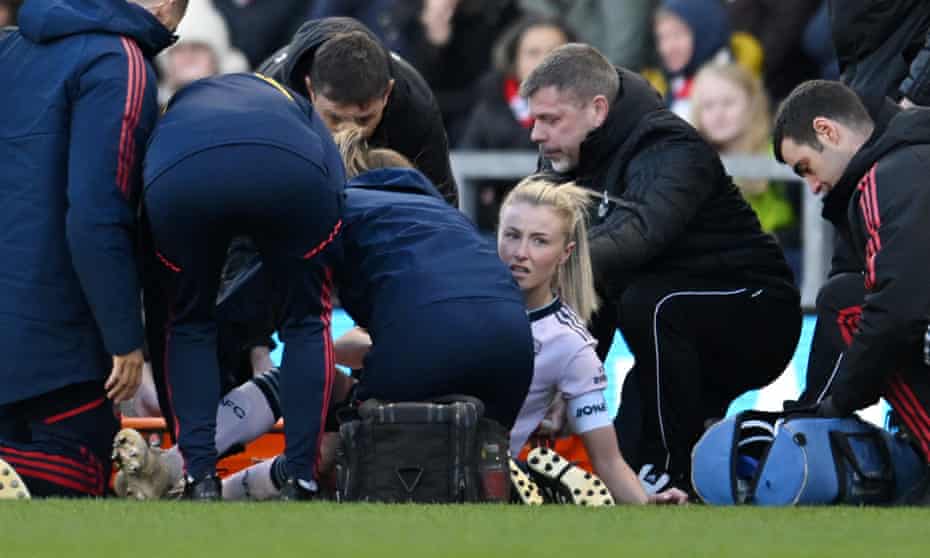
The football world was left stunned after news broke that Leah Williamson would miss the FIFA Women’s World Cup following a devastating anterior cruciate ligament injury. The England captain and defensive leader suffered the injury while playing for
 during a Women’s Super League clash against Manchester United, a moment that immediately raised fears among supporters and teammates alike. Those fears were later confirmed when medical scans revealed a ruptured ACL, ruling Williamson out of the tournament in Australia and New Zealand.
For England, the injury represented more than simply losing a player. Williamson had become the heartbeat of the Lionesses since taking over the captaincy, leading the national side to their historic UEFA Women’s Euro 2022 triumph. Calm under pressure, tactically intelligent, and respected throughout the dressing room, she symbolized the growth and confidence of women’s football in England. Her absence ahead of the World Cup instantly created uncertainty around a team that had entered the tournament as one of the favorites.
The injury occurred during Arsenal’s league match against Manchester United when Williamson appeared to twist awkwardly after her studs caught in the turf. She immediately fell to the ground in visible pain before receiving medical attention and eventually being helped off the pitch. Fans feared the worst, especially given the growing number of ACL injuries affecting elite women footballers in recent years.
Soon afterward, Arsenal released a statement confirming the diagnosis. The club announced that Williamson had ruptured her anterior cruciate ligament and would undergo surgery followed by a lengthy rehabilitation period. The recovery timeline for ACL injuries often stretches across several months, making participation at the World Cup impossible.
Williamson herself later addressed the heartbreaking news in an emotional message shared on social media. She admitted that her “World Cup and Champions League dream” was over, while also acknowledging the difficult mental and physical road ahead. Her statement resonated deeply with fans because it reflected not only the disappointment of missing a major tournament, but also the emotional burden athletes carry during long-term injuries.
At just 26 years old at the time of the injury, Williamson was widely regarded as one of the best defenders in women’s football. Her performances during Euro 2022 helped transform England into champions on home soil, with her composure and leadership playing a central role in the Lionesses’ success. She was named in the Team of the Tournament and praised for her ability to organize the defense while remaining calm in high-pressure moments.
The timing of the injury could hardly have been worse for England manager Sarina Wiegman. The Lionesses were already dealing with injury concerns before the World Cup, and Williamson’s absence added to an alarming list that included several important players. Fellow Arsenal star Beth Mead was also expected to miss the tournament because of an ACL injury suffered months earlier.
Williamson’s defensive partnership with Millie Bright had been one of England’s biggest strengths. Together, the pair combined leadership, physicality, and tactical awareness, forming the backbone of the side that conquered Europe in 2022. Questions quickly emerged over who would step up in Williamson’s absence and whether England could maintain the same defensive stability without their captain.
Despite the devastating setback, Williamson received overwhelming support from across the football world. Teammates, clubs, former players, and supporters flooded social media with messages of encouragement. Many pointed to her professionalism, mental toughness, and determination as reasons to believe she would successfully return to the highest level. The injury also reignited discussions surrounding the growing number of ACL injuries in women’s football and the urgent need for more research into prevention methods.
Experts and researchers have increasingly highlighted that female footballers are statistically more likely to suffer ACL injuries than male players. Concerns surrounding workload, scheduling, pitch conditions, footwear, and limited women-focused sports science research have all become major talking points within the game. Williamson’s injury became another high-profile example in what many observers described as an “ACL epidemic” in women’s football.
England ultimately had to adapt heading into the World Cup without their inspirational leader. Younger defenders and less experienced players were forced into bigger responsibilities, while Wiegman reshaped her tactical plans around Williamson’s absence. Although the Lionesses still managed an impressive run to the final, many supporters wondered how different the tournament might have looked with their captain available.
For Williamson personally, the road back required immense patience and discipline. ACL rehabilitation is notoriously demanding, both physically and mentally. Players must rebuild strength, confidence, and mobility while resisting the temptation to rush back too early. Throughout her recovery, Williamson remained visible around the England and Arsenal setups, continuing to support teammates and maintain her leadership presence even while sideline.
Her eventual return to football in 2024 was celebrated widely by fans and teammates alike. Williamson’s comeback demonstrated the resilience that had already defined much of her career. She gradually worked her way back into both club and international football, proving once again why she remains one of the most admired figures in the women’s game.
The injury also became part of a broader conversation about protecting athletes in women’s football. Clubs, federations, and researchers have since intensified efforts to better understand why ACL injuries occur so frequently among female players. New projects and collaborative research initiatives have emerged with the aim of improving injury prevention, training methods, and long-term player welfare.
Although missing the World Cup was one of the most painful moments of Williamson’s career, it did not define her legacy. Instead, the manner in which she handled the setback only strengthened the admiration many supporters already had for her. Her professionalism, honesty, and determination turned a heartbreaking situation into an example of resilience and leadership.
For England supporters, the news of Williamson’s injury was a crushing blow. Yet it also served as a reminder of the unpredictability and emotional intensity of sport. One moment, a player can be preparing to lead their country onto the world stage; the next, they are beginning months of recovery away from the spotlight.
Even so, Williamson’s story remains far from over. Her return to elite football after such a devastating injury proved that setbacks do not have to end greatness. Instead, they can become part of a journey that inspires millions both on and off the pitch.